Description
Experience an exciting space odyssey with the Project Planet app, which brings the entire solar system within your reach. Just a swipe of your finger takes you through all eight planets, from Mercury to Neptune, and maybe beyond :). Each celestial body is displayed with playful graphics and concise, essential information, making exploring our solar system both fun and educational.
Key Features:
Planetary Exploration: Effortlessly navigate through a colorful and intuitive interface that brings the solar system’s eight unique planets to life.
Interactive Learning: Get to know each planet through engaging and easily understandable stats – discover their distance from the Sun, comparative sizes, surface temperatures, and much more.
Personalized Discovery: Enter your weight and age to find out how much you would weigh on each planet – a fun twist that adds a personal touch to your space exploration.
Please note: Project Planet requires an internet connection as it runs on a webview interface. The app leverages native iOS capabilities such as haptic feedback to enhance the tactile sensation of your interstellar journey.
Nouveautés (v2.0)
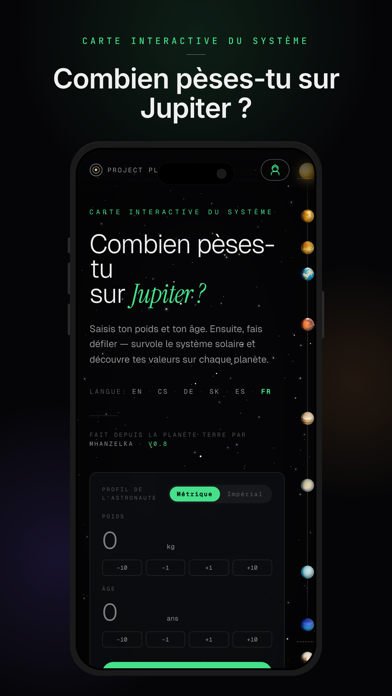
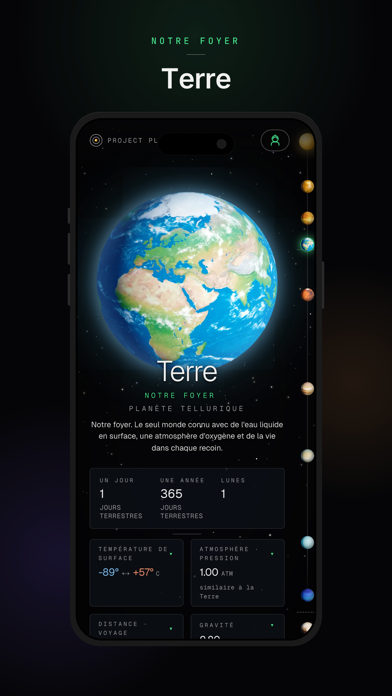
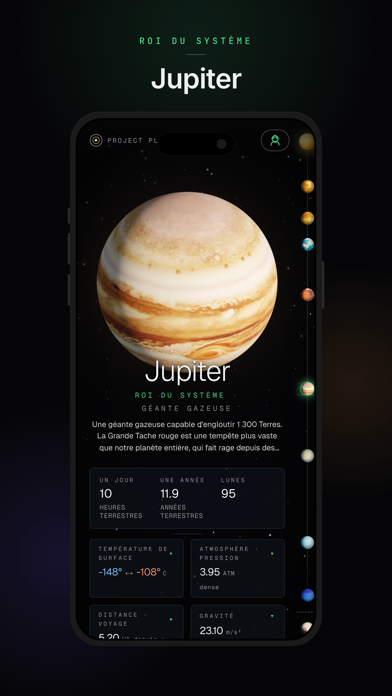
Project Planet 2.0 est une refonte complète — nouvelle palette sombre, typographie Geist + Instrument Serif, texte du hero « Combien pèses-tu sur Jupiter ? », tagline caractéristique pour chaque planète (PLANÈTE ROUGE, NOTRE FOYER, ROI DU SYSTÈME…), fond étoilé à trois couches en parallaxe.
• Cinq nouvelles langues — l'allemand, le slovaque, l'espagnol et le français rejoignent l'anglais et le tchèque
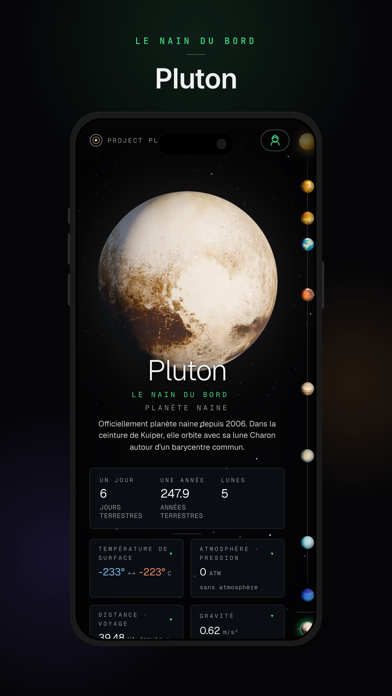
• Quatre widgets dépliables par planète : température (°C/°F avec marqueurs de référence), atmosphère et pression (simulateur interactif avec points d'ébullition de différentes substances), distance et voyage (orbite elliptique, temps de voyage), gravité (phrase de « ressenti » par planète et tableau « combien pèsent les objets du quotidien »)
• Profil de l'astronaute — le poids et l'âge sont enregistrés localement et recalculés pour chaque planète
• Halos atmosphériques autour de Vénus, Terre, Mars, Uranus et Neptune ; Lune derrière la Terre avec une légère parallaxe ; diagrammes orbitaux elliptiques avec périhélie et aphélie
• Vraies températures moyennes de la NASA et extrêmes terrestres corrigés (Death Valley 57 °C — l'OMM a invalidé le record d'Aziziya de 1922 en 2012)