Description
Project Planet - an interactive map of our solar system
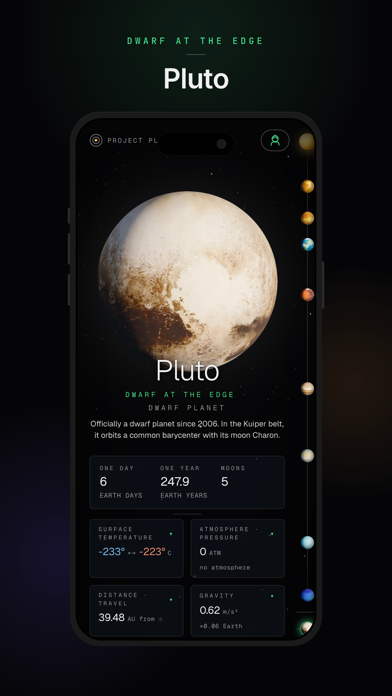
How much would you weigh on Jupiter? Why does a day on Mercury last longer than its year? Project Planet turns space facts into a fingertip-sized journey. Scroll through all nine planets (Pluto included), feel each world's pull on your own body, and explore the numbers astronomers have spent decades collecting.
Highlights
- Sticky scroll across the system: from Mercury to Pluto, each planet stays centred long enough for you to take it in.
- You, on every world: enter your weight and age once and watch them recalculated by each planet's gravity and orbital period.
- Five rich widgets per planet: surface temperature with reference markers (Antarctica, freezing, boiling), atmospheric pressure with composition chart, travel times from Earth from walking up to the speed of light, gravitational force with everyday objects (phone, backpack, car), and an interactive pressure simulator with phase changes for water, oxygen, CO2, hydrogen, nitrogen and mercury (Antoine equation under the hood).
- Six languages: Czech, English, German, Slovak, Spanish and French, auto-detected from your device.
- Metric or imperial: switch instantly; weights, temperatures and distances follow your preference.
- Crafted to feel like a small cosmic museum: dark cosmic theme, hand-tuned typography, subtle scroll choreography, and a right rail that lets you jump to any planet.
- Built on real data: gravitational accelerations, orbital periods, NASA mean temperatures, atmospheric compositions and substance phase transitions.
Requires an internet connection. The app runs as a continuously updated webview and uses native iOS capabilities such as haptic feedback to add a tactile dimension to your interstellar journey.
What's new (v2.0)
Project Planet 2.0 is a complete redesign — new dark palette, Geist + Instrument Serif typography, hero copy "How much do you weigh on Jupiter?", per-planet taglines (RED PLANET, OUR HOME, KING OF THE SYSTEM…), three-layer parallax starry background.
• Five new languages — German, Slovak, Spanish, and French join English and Czech
• Four expandable widgets per planet: temperature (°C/°F with reference markers), atmosphere & pressure (interactive simulator with substance boiling points), distance & travel (elliptical orbit, travel times), gravity (per-planet "feel" sentence and "everyday objects" table)
• Astronaut profile — weight and age save locally and recalculate for every planet
• Atmospheric halos around Venus, Earth, Mars, Uranus, and Neptune; Moon behind Earth with subtle parallax; elliptical orbit diagrams with perihelion and aphelion
• Real NASA mean temperatures, plus corrected Earth extremes (Death Valley 57 °C — WMO invalidated the 1922 Aziziya record in 2012)